










Why the haul loop is going electric
The first reason is a fuel bill. On a mine haul ramp, a 90 t class truck burns diesel at a rate that makes energy the largest operating line item after labour. The second reason is that a haul truck spends most of its life doing the same thing: climb loaded, descend empty, stop, reverse under the shovel. That fixed, repeating cycle is exactly what an electric drivetrain is good at, because regenerative braking on the loaded descent feeds energy back into the pack for the next climb. Diesel trucks throw that energy away as heat on the brake grids.
The third reason is regulatory. Mining jurisdictions from Chile to Canada and China are tightening emissions limits on pit equipment, and buyers of copper, lithium and iron ore increasingly ask what a mine's Scope 1 profile looks like. An electric truck does not solve a mine's whole decarbonisation problem, but on the haul loop it removes a large, measurable share of diesel consumption without changing the bench plan. We built the YTK90E as the first step and the line now runs to 100 t payload. For buyers still running diesel, the full rigid fleet is on the mining dump truck range page, and the operational-side questions — parts lead times, training, uptime — are covered on the after-sales support page.
Four technology routes, one decision
Pure electric, fast-charge. The truck plugs into a high-voltage DC charger at the pit or the load-out between cycles. This suits mines with a grid connection and short, predictable loops — typically under 4 to 6 km one-way — where charge windows fit the shift pattern. Energy cost per tonne-kilometre is lowest of all routes.
Battery swap. A depleted pack is exchanged for a charged one in minutes at a swap station, so the truck stays on the cycle instead of sitting on a charger. This is the route for 24/7 fleets and for mines that want to decouple charging from the truck's working hours.
Range-extended. A small buffer battery plus a diesel genset. The genset tops the pack up on route, so there is no charging infrastructure at all and no range anxiety on long ramps. Fuel use is still a fraction of a diesel truck because the genset runs at its efficient operating point instead of following the full load demand.
Diesel-electric hybrid. A diesel engine drives a generator and the electric axle does the traction work, with a modest buffer pack for regeneration. Best for mines that will add charging later but cannot wait for grid work now.
Hydrogen fuel-cell haul trucks are being piloted in a few operations worldwide; the practical blockers today are hydrogen supply at the mine, tanker logistics and fuel-cell service networks. For most mines the four routes above are the ones you can actually procure and run now.
| Route | Charging infrastructure | Best duty cycle | Energy cost vs diesel |
|---|---|---|---|
| Pure electric, fast-charge | Grid + DC chargers at pit or load-out | Short loops, fixed shift windows | Lowest, where grid power is cheap |
| Battery-swap | Swap station, battery pool | 24/7 multi-shift fleets | Low, plus battery-pool capital |
| Range-extended | None (diesel genset on board) | Remote pits, long ramps, no grid | Moderate — genset runs at efficient point |
| Diesel-electric hybrid | None (engine + generator) | Transition fleets, pre-grid | Moderate, near diesel fuel cost |
The full YTK electric line-up, side by side
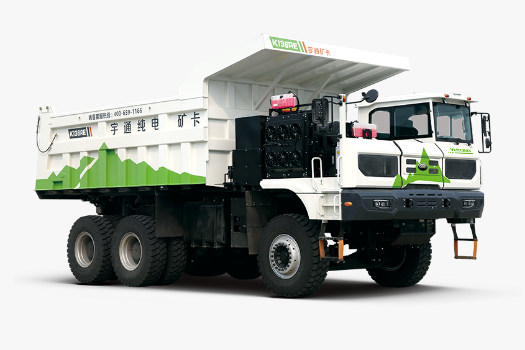
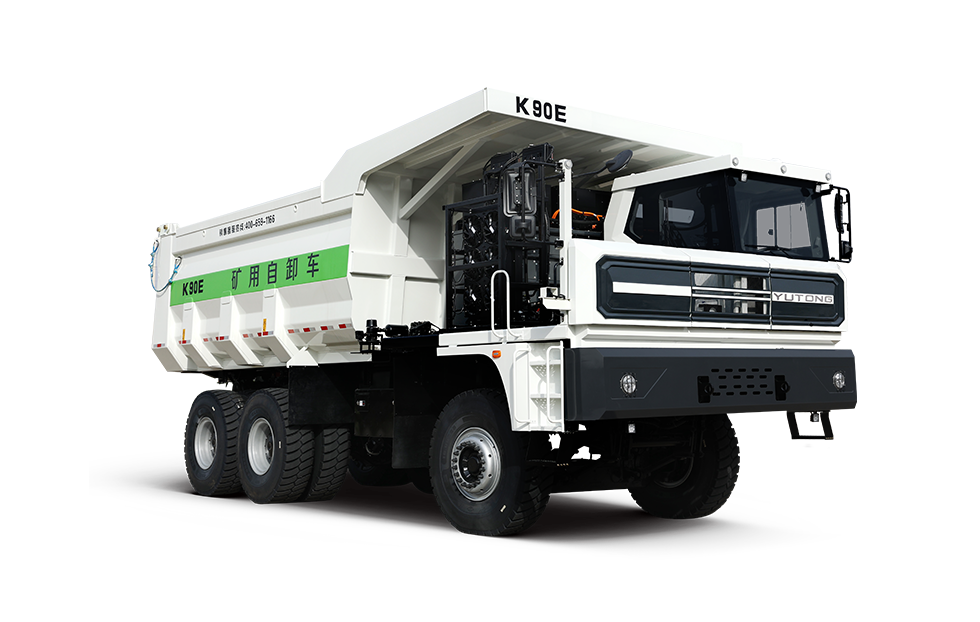
All seven models below are built on the Rui-Control E mining platform: Yutong's own vehicle controller, integrated coaxial drive motors and lithium iron phosphate packs chosen for mine temperature range and cycle life. Rated payloads are declared per the manufacturer's spec sheet; verify your shovel pass count against the body volume before ordering. The two 90 t models cover opposite situations — the YTK136E vs YTK136RE comparison walks through when swap beats range-extended and vice versa, and the YTK105E vs YTK120E comparison does the same for the 70 t and 80 t classes.
| Model | Rated load | Drivetrain | Energy storage | Best fit |
|---|---|---|---|---|
| YTK90E | 60 t | Pure electric, fast-charge or swap | LFP 704 / 800 kWh | Aggregate, small pits, first electrification step |
| YTK105E | 70 t | Pure electric | LFP 704 / 800 kWh | Copper and gold pits, 42 m³ U-shaped body |
| YTK120E | 80 t | Pure electric | LFP 528 / 704 kWh | Mid-size open pits, 42 m³ body, ≤25 m turning |
| YTK136E | 90 t | Battery-swap | LFP 600 / 704 / 800 kWh | 24/7 multi-shift fleets with a swap station |
| YTK136RE | 90 t | Range-extended | 117 kWh buffer + genset | Remote pits with no charging grid |
| YTK140HE | 100 t | Diesel-electric hybrid | 176 kWh buffer + generator | Heavy fleets phasing in electrification |
| YTK145E | 100 t | Pure electric | LFP 704 / 800 kWh | High-tonnage green mine fleets |
Charging and swapping infrastructure: what the site actually needs
Grid connection first. Before any charger is ordered, know the connection capacity available at the pit. A single 90 t class truck on fast charge can draw more than the substation behind a small site is sized for, so the power demand calculation comes before the charger count. We size this with the fleet order rather than leaving it to site electricians to discover in month three.
Fast charging. High-voltage DC chargers placed at the load-out or pit bottom let trucks charge during shift breaks and loader changes. The pack chemistry is lithium iron phosphate, selected for thermal stability and calendar life in mine temperatures; charging behaviour at the top and bottom of state-of-charge is managed by the vehicle controller.
Battery swap. A swap station holds a pool of packs, lifts the depleted pack out and installs a charged one in minutes. The truck's working hours no longer depend on charge time. The economics work when the fleet is large enough that the battery pool is amortised over many trucks and shifts.
Remote sites. Where there is no grid, the range-extended and hybrid models run with only fuel logistics. Telematics on the electric fleet — battery state, energy per cycle, charger availability — is covered on the fleet telematics page, which also explains how we use the same platform to manage diesel fleets.
TCO: where the electric truck wins, and where it does not
The honest total-cost picture for an electric haul truck has four big levers. Energy cost per tonne-kilometre is lower wherever grid electricity is cheaper than delivered diesel — which is most grid-connected mines, and the gap widens as diesel logistics into remote pits get more expensive. Maintenance is lighter because there is no engine, no transmission oil circuit and no brake grids to service; regenerative braking does much of the braking work, so service brakes last longer. Uptime on a well-run electric fleet tends to rise because the drivetrain has fewer wearing parts and fault codes are read remotely before they become stops.
Where the electric case is weaker: battery capital is front-loaded and replacement packs carry a real cost at end of life; fast-charge fleets need disciplined shift scheduling so trucks are on the charger in their window; and very long one-way hauls push you toward the range-extended or hybrid route because pure-electric energy density still cannot match a tank of diesel. Model these against your actual ramp profile and shift pattern — the planning figures below are a starting point, not a quote.
| Lever | Electric fast-charge | Range-extended | Diesel |
|---|---|---|---|
| Energy per t-km | Lowest with cheap grid power | Moderate | Highest, tracks diesel price |
| Drivetrain maintenance | Low — no engine oil, no transmission | Low, plus genset service | Full engine and transmission service |
| Brake maintenance | Low — regen does most braking | Low | High — brake grids and service brakes |
| Battery capital / replacement | Front-loaded, pack at EOL | Smaller pack | None |
| Shift flexibility | Needs charge-window discipline | Full flexibility | Full flexibility |
Two worked angles: a copper pit in Chile running the electric route on cheap solar-backed power is a different economic case from a far-north mine buying diesel by road in winter. For the practical method behind class selection — payload, bench width, ramp grade, cycle time — see the mining dump truck selection guide.
Frequently asked questions
Which electric mining truck models does Yutong offer?
The line-up runs from 60 t to 100 t: YTK90E (60 t), YTK105E (70 t), YTK120E (80 t), YTK136E (90 t battery-swap), YTK136RE (90 t range-extended), YTK140HE (100 t hybrid) and YTK145E (100 t pure-electric), all on the Rui-Control E platform.
What is the difference between fast-charge, battery-swap and range-extended?
Fast-charge trucks plug into high-voltage DC chargers between cycles and suit grid-connected sites with short loops. Battery-swap trucks exchange packs in minutes and suit 24/7 fleets. Range-extended trucks carry a small battery plus a diesel genset and suit remote pits with no charging grid.
How much energy does an electric mining truck use versus diesel?
It depends on the cycle. A loaded haul uphill is the energy-heavy leg; regenerative braking on the loaded descent returns a share of it. Yutong's electric platform recovers roughly 60 percent more energy than the industry average on typical ramp cycles. Model kWh per tonne-kilometre against your real cycle before choosing a route.
Can Yutong supply the charging or swap infrastructure?
Yes. We package trucks with fast-charging or battery-swap station design, power demand calculation and fleet-level proposals. Send the grid connection, ramp profile and shift pattern and the engineering team sizes the infrastructure with the fleet.
Do electric mining trucks work in cold climates or at high altitude?
Lithium iron phosphate packs hold output well in cold, and an electric drive does not lose power with altitude the way a naturally aspirated diesel does. Cold-climate packages add battery and cabin heating for sites below -20 °C; confirm battery capacity and heating options against your site temperature range.
Send us your ramp profile and we will size the electric fleet
Tell us the truck class you run today, one-way haul distance, ramp grade, shift pattern, grid connection capacity at the pit, and daily tonnes to move. Our mining engineering team will match the Yutong mining dump truck range across the electric, swap, range-extended and hybrid routes, and size the charging or swap infrastructure with it. The same team supports the wider new energy truck line-up for on-road haulage.