










Start from the cycle, not from the brochure
Most truck selection mistakes happen at the very first step: someone picks a tonnage off a price list and then makes the mine fit the truck. The reverse is faster and cheaper. Your pit already has fixed numbers — daily tonnage to move, bench width, haul-road length, maximum ramp grade, loader bucket size, and the local price of diesel and grid electricity. A good mining dump truck choice is simply the smallest truck that still moves those numbers without a queue at the shovel. Below is the decision tree we run with customers, followed by the parameter definitions that engineers usually argue about.
The decision tree: five questions before you spec a truck
1. Tonnage. Divide daily tonnage by effective working hours to get tonnes/hour, then by expected cycles/hour to get required payload. If the answer lands between classes, round down and add trucks rather than buying one oversized truck that cannot load in narrow benches.
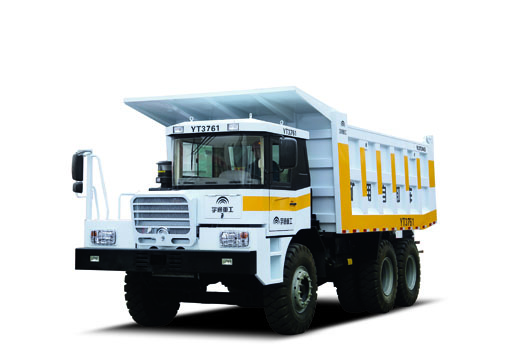
2. Road surface and bench width. Under 30 m bench width and soft haul road favours the 40 to 50 t class such as the YT3621 or YT3761, which turn in tighter space. Wide, hardened benches let you step up to 60 t and above.
3. Haul distance. Under 3 km one way, a short cycle rewards a fast-loading, agile truck. Over 5 km, fuel or energy efficiency per tonne-km dominates and a larger, efficient truck wins.
4. Fuel type. Diesel for remote, long, variable routes; pure electric or battery-swap for short, repeatable cycles with grid power on site.
5. Budget and TCO. Compare purchase price, energy cost, tyre wear and downtime together — not the sticker price alone.
The parameters engineers actually argue about
These four terms are where two buyers "compare" trucks that are not comparable at all. Get the definitions right and the table comparison becomes honest.
| Parameter | What it really means | How to use it in selection |
|---|---|---|
| Payload (rated load) | Maximum ore mass the truck is engineered and permitted to carry. | The number to match against your required tonnes/cycle. Never exceed it; overloading kills tyres and frame fatigue life. |
| GVW (gross vehicle weight) | Truck tare weight plus payload combined. | Used for ramp gradeability, rolling resistance and haul-road / bridge loading. Always size ramps and roads to GVW. |
| Heaped body volume | Level struck box plus a 1:1 or 2:1 side pile. | Multiply by material density to get real tonnes; confirm it stays under rated payload. Coal needs more volume per tonne than iron ore. |
| Struck body volume | The flat, level box only, no heap. | The conservative baseline for free-flowing fines where material does not self-stack. |
| Gradeability | Steepest sustained slope climbable at full GVW. | Match to your worst 200 m of ramp. A flat-road efficient truck will struggle and overheat on a 10% ramp. |
| Retarder / braking | Ability to control speed down long descents without rider brakes. | More important than power on pits with long down-haul. Saves brake replacements and prevents runaway. |
Match the class to the ore: copper, coal, lithium, iron
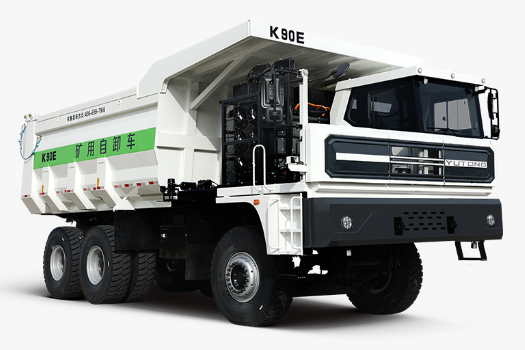
Coal mines. Coal is light (roughly 0.8 to 1.0 t/m3), so a truck hits body volume before it hits payload. A 60 to 70 t electric truck such as the YTK90E or YTK105E with a large body works well, especially where the mine runs on grid power and wants to cut pit diesel fumes.
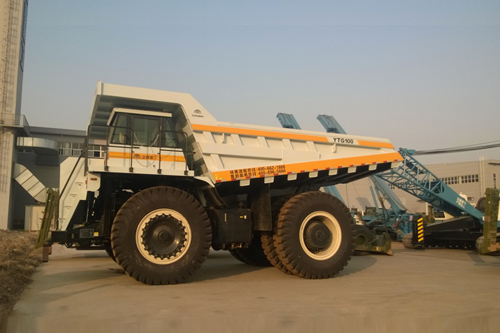
Iron ore and hard rock. Dense (2.5 to 2.8 t/m3), so trucks reach payload quickly and a smaller body suffices. The 80 to 100 t class — YTK120E, YTG100 or YTK145E — moves more tonnes per cycle on wide benches.
Copper pits. Often large benches with long ramps; a 70 to 90 t truck with strong gradeability and retarder capacity keeps cycle time steady through the life-of-mine pushback.
Lithium and soft-rock mines. Younger, narrower pits with lighter overburden; the 60 to 70 t class is agile on tighter benches and easier to resell as the pit deepens.
Fuel type and the TCO that decides it
The honest comparison is not diesel versus electric on a spec sheet; it is energy cost, maintenance cost and infrastructure cost over five years. A diesel truck has near-zero infrastructure cost and runs anywhere, but it carries a high per-tonne-km energy cost plus pit ventilation load. A pure-electric truck costs more to buy and needs chargers (or a battery-swap station like the one paired with the YTK136E), but it uses a fraction of the energy cost per tonne-km and has fewer wearing parts. The break-even point moves hard with your local diesel price and electricity tariff, so plug those two numbers in before you decide. For mines that want the flexibility to leave the pit, a range-extended model such as the YTK136RE bridges the gap: electric around the pit, a diesel range extender for the rare long move.
| Powertrain | Purchase price | Energy cost per t-km | Infrastructure | Best fit |
|---|---|---|---|---|
| Diesel | Lower | High | None | Long hauls, remote sites, variable duty cycles |
| Pure electric (charge) | Higher | Low | Chargers | Short repeat cycles, grid power, small fleet |
| Battery swap | Higher | Low | Swap station | Large fleets on continuous 24 h shifts |
| Range-extended / hybrid | Higher | Medium | Minimal | Pits without full charging infrastructure |
Five mistakes we see on real sites
1. Oversizing to "future-proof". A 100 t truck bought for a 30 m bench spends its life turning slowly and under-loaded, and costs more to run per tonne. Buy for today's bench; add trucks later.
2. Matching truck to loader wrong. If the shovel needs 8 passes to fill the truck, cycle time collapses. Target 4 to 6 passes.
3. Ignoring ramp gradeability. A flat-road-efficient truck crawls up an 8 to 10% ramp and overheats descending it. Test on the worst 200 m.
4. Comparing heaped volume across different materials. The same body carries very different tonnes of coal versus iron. Always convert.
5. Buying on sticker price only. The cheapest truck can be the most expensive over five years once tyres, downtime and energy are included. Build the TCO.
Frequently asked questions
What payload class of mining dump truck do I actually need?
Start from daily tonnage and the loader's bucket size, not a round number. A 40 to 50 t truck pairs with a 5 to 8 m3 bucket on benches under about 30 m wide; a 60 to 90 t truck pairs with a 10 to 15 m3 shovel on wider benches. Aim for 4 to 6 loader passes to fill the truck.
What is the difference between payload and GVW?
Payload is the ore the truck may carry (e.g. 60 t). GVW is the truck's own mass plus that payload (e.g. ~105 t). Ramp grade, rolling resistance and haul-road loading are all calculated on GVW, not on payload alone.
Heaped or struck volume - which should I compare?
Struck is the level flat box; heaped adds a side pile on top. Multiply heaped volume by material density to get real tonnes (granite ~2.6 t/m3, coal ~0.9 t/m3), then confirm the figure stays under rated payload.
When should I choose electric over diesel?
Electric wins on short, repeatable 1 to 3 km cycles with grid power or a swap station and where diesel or pit-ventilation cost is high. Diesel still wins for hauls over 5 km, remote sites and trucks that must leave the pit road at short notice.
How does haul-road grade change the choice?
Gradeability is the steepest sustained slope climbable at full GVW. Pits with 8 to 10% ramps need enough power-to-weight and strong retarder on the descent. Always run the spec against the worst 200 m of ramp on the route.
What is a realistic TCO split over five years?
Energy and fuel is usually the largest controllable line item, followed by tyres and maintenance. Diesel has high running cost but no infrastructure cost; electric has higher purchase and charger cost but far lower energy and maintenance cost per tonne-km. Model it with your own diesel and electricity prices.
Battery swap or fast-charge electric truck?
Swap keeps the truck productive on 24 h pits (a swap takes minutes), so it suits large continuous fleets. Fast charge is cheaper to install for a small fleet with predictable idle time. Choose swap for round-the-clock production; charge for smaller fleets.
Send us your route numbers and we will size the truck
Tell us the daily tonnage, one-way haul distance, worst ramp grade, bench width, material density and local diesel / electricity price, and our mining engineering team will match you to the right class across the Yutong mining dump truck range — from the 40 t rigid class up to the 100 t electric and hybrid models. We export to over 60 countries and build to FOB / CIF shipment terms with the full customs document set.