










Why Southeast Asia lifts differently
Southeast Asia is not one lifting market - it is three geologies at once. In Sulawesi, laterite nickel pits sit on soft, unprepared ground where the wet season turns the access road into laterite mud; a crane that needs a paved hardstand and four outriggers is a crane that waits for the dry season. In Kalimantan, coal sites operate on similar soft ground with long hauls to river jetties. In the Philippines, infrastructure work is mostly urban and road-accessible - bridges, housing, plant erection - where a crane's ability to drive between jobs matters more than its off-road reach. In Vietnam, wind farms climb coastal ridges and hills with no sealed roads, and the lift itself - tower sections, nacelle, blades - demands long boom reach at height.
Across all of them, the machine arrives by sea freight from China and then faces a year-round humid climate, monsoon rain in wet season, and salt air on every coast. That drives two spec decisions that do not come up in a temperate crane purchase: ground-pressure and mobility for the crawler line, and corrosion protection for the whole machine. Below we walk through the three markets, the hoisting equipment class that fits each, and the tropical-duty engineering. The regional mining context is on the Southeast Asia mining equipment page, the construction side on the Southeast Asia construction machinery page, and the municipal/special-vehicle side on the Southeast Asia special vehicle page.
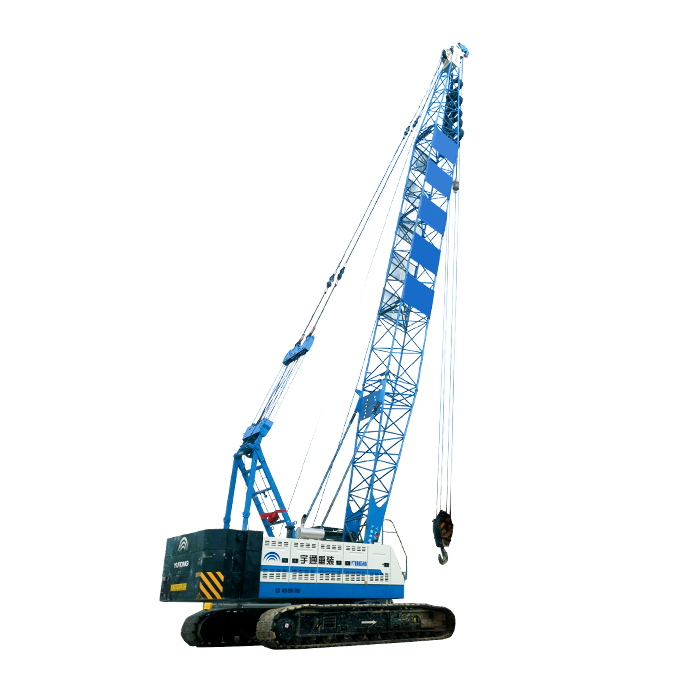
Indonesia: crawler cranes on soft nickel and coal ground
Ground pressure is the spec, not the headline tonnage. A wheeled or truck crane on a Sulawesi nickel pit would sink on laterite in the wet season and would need outrigger mats that are impractical on a moving site face. The heavy-duty crawler crane carries the load on its tracks with low ground pressure, travels between lift points under its own power, and lifts without outrigger setup. That is the reason the 55 t YTQU55HDS and 65 t YTQU65HDS units are the common mine-class machines: they cover pipe, structural and equipment lifts in the 55-65 t range while staying mobile across an unprepared site.
Self-erection cuts mobilisation. On a remote pit with no assist crane on site, the crawler rigs itself using its self-erecting track carrier and hydraulic boom assembly - no second crane is needed to assemble the boom sections. That matters on Indonesian island sites where moving a second machine across water and laterite is slow and expensive. A worked example of the coal-side lifting logic is on the Indonesia coal case.
Capacity falls with radius. Rated capacity drops sharply as the boom extends and the working radius grows, so the purchase decision is driven by the load chart at the planned radius - usually the heaviest lift at the farthest reach - not the model's headline tonnage. We supply the load chart and advise on counterweight and boom configuration for the actual lift plan rather than a generic number.
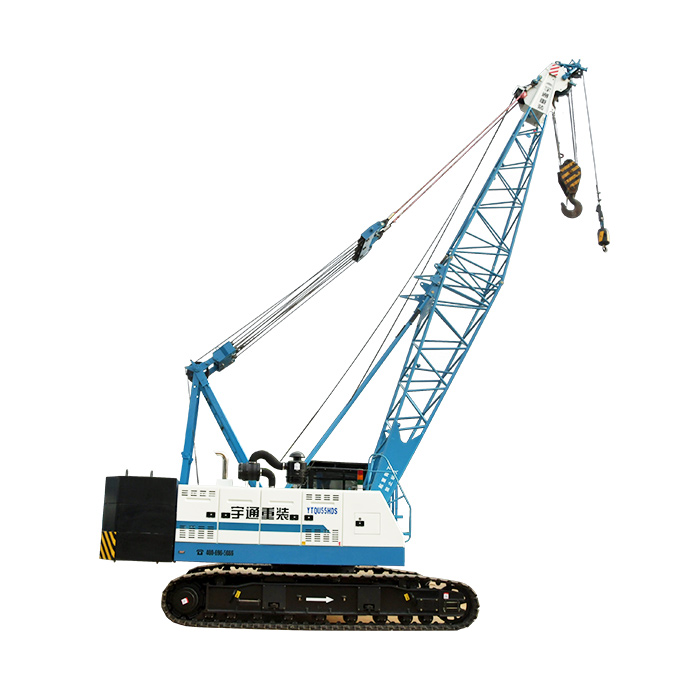
Vietnam wind and Philippine infrastructure: long reach and road mobility
Wind duty needs the 75-100 t class. Vietnamese wind farms on coastal ridges need tower sections lifted to hub height and the nacelle set at the top - long-reach lattice boom work at radius, on rough access roads. That is the stated duty of the 75 t YTQU75HDS and 100 t YTQU100HDS class: the 75-100 t range is used to assemble wind turbine towers and nacelles where the crawler's low ground pressure and track mobility matter more than road speed. The wind-farm lifting sequence is detailed on the wind turbine crawler crane case.
Philippine urban sites want a truck-mounted crane. Where the job is bridge girder setting, building erection or plant work in or near a city, ground pressure is not the constraint - traffic, street width and the need to move between daily sites are. The truck-mounted crane drives to site on its own axles, sets on outriggers, and leaves when the lift is done, which is the standard answer for road-accessible Philippine infrastructure. For medium lifts on unprepared industrial yards that need track mobility without the full 55-100 t crawler, the hydraulic crawler crane range covers the duty.
Sea freight and site arrival. Cranes ship from Chinese ports and arrive at the nearest Indonesian, Philippine or Vietnamese port, then travel the final leg by road or barge to site. We quote FOB, CIF or DAP and ship the full document set for local clearance; standard configurations ship in 4 to 8 weeks, with custom boom and counterweight packages in 8 to 12 weeks.
Crane class x Southeast Asian lift profile
| Market / application | Crane class | Lift profile and why |
|---|---|---|
| Indonesia nickel pit, Sulawesi (soft laterite) | 55-65 t crawler - YTQU55HDS, YTQU65HDS | Low ground pressure, no outrigger hardstand needed; self-erects; site assembly, pipe and structural lifts on wet-season ground |
| Indonesia coal site, Kalimantan | 55-65 t crawler class | Track mobility between pit and river jetty; lifts on unprepared haul roads; load chart matched to radius, not headline tonnage |
| Vietnam wind farm erection (ridge sites) | 75-100 t crawler - YTQU75HDS, YTQU100HDS | Long-reach lattice boom for tower sections and nacelle at hub height; rough access roads; low ground pressure over sealed-road-less terrain |
| Philippine urban / road-accessible infrastructure | Truck-mounted crane | Drives to site on own axles; sets on outriggers on paved urban ground; moves between daily jobs where off-road reach is not the constraint |
| Medium industrial / unprepared yard lifts | Hydraulic crawler crane range (p-1093) | Medium lifts needing track mobility without the full 55-100 t crawler; industrial yards and plant erection |
Tropical duty and regional parts support
Humidity, monsoon and salt air. A crane that survives a temperate yard does not automatically survive a Southeast Asian coast. Year-round high humidity drives condensation inside sealed compartments; monsoon rain tests drainage and seals; coastal salt air attacks unpainted structure, fasteners and electrical contacts. The practical package is sealed electrical enclosures, corrosion-protected structure and fastener treatment, a lubrication and drainage schedule written into the maintenance plan, and storage guidance for machines sitting idle through the wet season. These are configured into the export machine rather than discovered after delivery.
Heat. While not as extreme as a Gulf summer, sustained 30-35 degree C plus high humidity is a real cooling load on the hydraulic circuit and drivetrain through long lift cycles. Cooling is sized for that duty so the crane does not derate through an afternoon of continuous lifting.
Warranty and parts. Cranes carry a 12-month or 2,000-hour warranty with regional spare-parts support, delivered through the dealer network in the region. Fast-moving wear parts - hydraulic seals, boom pins, rope and sheave components - are quoted as starter kits with the first order so a remote Indonesian or Vietnamese site is not waiting 4-8 weeks for a sea-freight replacement. For how a fleet of machines is monitored in the field, the telematics page covers utilisation, hour-meter and maintenance-alert tracking across a distributed crane fleet.
Frequently asked questions
Which crawler crane capacity classes do you supply to Southeast Asia?
The YTQU hydraulic crawler line spans roughly 55 to 100 tonnes: the YTQU55HDS at 55 t, YTQU65HDS at 65 t, YTQU75HDS at 75 t and YTQU100HDS at 100 t. Capacity at the actual working radius, not the headline number, decides which model fits; we provide the load chart for the planned boom angle and radius.
Why a crawler crane for Indonesian nickel and coal mines?
Sulawesi nickel sites and Kalimantan coal sites sit on soft, unprepared ground with no paved hardstand. A crawler crane travels and lifts on its tracks with no outrigger setup and has low ground pressure, so it can work on wet-season laterite without the matting and road permits a truck crane would need. The 55 to 65 t class suits site assembly, pipe and structural lifts in the pit.
Which class is used for wind turbine erection in Vietnam?
The 75 to 100 tonne class - YTQU75HDS and YTQU100HDS - is used to assemble wind turbine towers and nacelles on rough access roads, where long-reach lattice boom and the crawler's low ground pressure matter more than road speed. The crane self-erects with its own track carrier and hydraulic boom, so no second assist crane is needed on a remote ridge.
Do you supply truck-mounted cranes for urban Philippine sites?
Yes. For road-accessible urban and infrastructure sites where mobility between jobs matters more than off-road reach, the truck-mounted crane drives to site on its own axles and sets on outriggers. For medium lifts on unprepared industrial yards, the hydraulic crawler crane range covers the duty. Tell us the lift radius and ground conditions and we will match the class.
How do you protect cranes from tropical humidity and salt air?
Southeast Asian duty - year-round high humidity, monsoon rain and coastal salt air - drives corrosion protection: sealed electrical enclosures, corrosion-protected structure and fastener treatment, and a maintenance schedule that addresses lubrication and drainage. Standard configurations ship in 4 to 8 weeks, custom boom and counterweight packages in 8 to 12 weeks, with a 12-month or 2,000-hour warranty and regional parts support.
Send us your lift plan and ground conditions
Tell us the site country (Indonesia, the Philippines, Vietnam or elsewhere), the heaviest lift, its working radius, ground bearing conditions in wet season, and whether the machine must travel between jobs. Our lifting engineering team will match the YTQU class - 55 t, 65 t, 75 t or 100 t - or the truck-mounted / hydraulic crawler option across the Yutong hoisting equipment range, and quote FOB, CIF or DAP in US dollars. For the same export logic applied to the Gulf infrastructure fleet, see the Middle East special vehicle page; for monitoring a distributed crane fleet, see telematics.