










Start from the loaded container, not from the brochure
Most hook lift truck selection mistakes happen at the first step: someone picks a capacity off a price list and then makes the containers fit the truck. The reverse is faster and cheaper. Your operation already has fixed numbers — the loaded container weight, container length, number of shared boxes, disposal site distance, and the local emission rules. A good hook lift choice is simply the smallest arm and chassis that still lifts your heaviest loaded container and drops it at the disposal site without overloading. Below is the decision tree we run with customers, followed by the parameter definitions that fleet managers usually argue about.
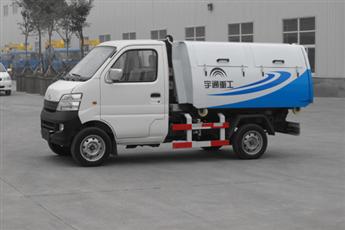
The decision tree: five questions before you spec a truck
1. Loaded container weight. Weigh a full container of your typical waste or debris. A light municipal skip needs a 1 t class such as the YTZ5020ZXXK0F. Construction debris needs a 14 t class such as the YTZ5160ZXX20E. Heavy scrap needs a 20 t such as the YTZ5250ZXX40E.
2. Container length range. List the shortest and longest boxes in your fleet. The hook arm must reach and lift the longest container. A short arm cannot load a long box.
3. Number of shared containers. The hook lift model works because one truck serves multiple boxes parked at different sites. The more boxes shared, the more productive the truck per shift. Calculate how many pickups per day the route demands.
4. Fuel type and emission rules. Urban waste collection in low-emission zones favours electric. Long rural routes and heavy debris favour diesel. Check local rules before ordering.
5. Budget and TCO. Compare purchase price, fuel or energy, arm maintenance and downtime together. A slightly larger truck that handles the heaviest box without renting a bigger one on peak days can win.
The parameters engineers actually argue about
These five terms are where two buyers "compare" hook lifts that are not comparable at all. Get the definitions right and the table comparison becomes honest.
| Parameter | What it really means | How to use it in selection |
|---|---|---|
| Lifting capacity (t) | Maximum loaded container weight the arm lifts. | Must exceed your heaviest loaded container. Never lift over-rated; it bends the arm. |
| Container length range (m) | Shortest to longest box the arm can load. | Must cover the full range of containers in your fleet. Spec for the longest box. |
| Chassis GVW (t) | Total loaded weight the truck can legally carry. | Container weight plus truck tare must stay under GVW. Overloading breaks the frame. |
| Arm type | Telescopic or fixed hook arm mechanism. | Telescopic handles a wider range of container lengths. Fixed arm suits a single box size. |
| Hook height | Height of the hook above the chassis. | Must match your containers' hook points. Mismatched hooks will not engage. |
| Chassis brand | Commercial truck platform the arm mounts on. | Choose a chassis your local service network supports. Dongfeng, Howo, Foton are common. |
Match the truck to the application: waste, construction, scrap
Municipal and commercial waste. Light skips and wheelie-bin containers in urban areas. A 1 to 5 t hook lift such as the 1 t class range navigates city streets and serves multiple shared boxes per route.
Construction and demolition debris. Heavy, bulky waste in 5 to 7 m roll-off boxes. A 14 t hook lift such as the 14 t model handles rubble, concrete and timber debris at demolition sites.
Industrial scrap and metal. Dense, heavy containers. A 20 t hook lift such as the 20 t model carries scrap metal boxes that weigh close to capacity when loaded.
Comparison with compactors. Where waste volume is the problem rather than container count, a compactor refuse truck compresses the load and carries more per trip. For multiple shared boxes across sites, the hook lift is the productive choice.
Hook lift vs compactor: which model fits the duty cycle
The honest comparison is not truck size on a spec sheet; it is how the truck serves your containers. A hook lift excels when you have multiple boxes parked at different sites and one truck shuttles between them: drop an empty, pick up a full, drive to disposal. It cycles fast and the containers are left on site for customers to fill. A compactor refuse truck drives a fixed route, empties bins directly into its body, and compresses the load on board. It suits curbside collection where there are no shared roll-off boxes. If your operation is a fleet of rented boxes across construction sites, the hook lift wins on flexibility. If it is daily curbside waste collection, a compactor truck is the right tool. Mixing both models covers both duties without compromise.
| Truck type | What it does | What it cannot do | Best fit |
|---|---|---|---|
| Hook lift (roll-off) | Shuttles shared boxes between sites | Does not collect from curbside bins | Construction sites, rented boxes, industrial yards |
| Compactor refuse truck | Empties bins, compresses on board | Does not leave boxes on site | Curbside collection, municipal routes |
| Sweeper truck | Cleans road surfaces | Does not carry waste containers | Street cleaning, not waste hauling |
Five mistakes we see on real fleets
1. Sizing to empty container weight, not loaded. An empty skip weighs 0.5 t but a loaded construction box weighs 14 t. Always size to the loaded weight.
2. Short arm for long containers. An arm rated for 4 m boxes cannot reach a 7 m roll-off. Spec the arm for your longest box.
3. Overloading the chassis GVW. A heavy container plus truck tare exceeds GVW, breaking the frame and voiding warranty. Stay under GVW with margin.
4. Mismatched hook height. The hook must engage the container's lift point. Mismatched hooks will not pick up the box safely.
5. Buying a hook lift for curbside collection. A hook lift shuttles boxes; it does not empty wheelie bins at the kerb. For that duty, a compactor truck is the right tool.
Frequently asked questions
What lifting capacity of hook lift truck do I need?
Start from the loaded container weight, not the empty container. A 1 t unit handles small skips. A 14 t unit handles construction debris. A 20 t unit handles heavy scrap. Always size to the heaviest loaded container in your fleet.
What container length fits my operation?
Hook lift arms are rated for a specific container length range. A light 1 t truck carries 2 to 4 m skips. A 14 to 20 t truck carries 5 to 7 m roll-off boxes. Specify the arm for your longest container.
Hook lift or container loader?
A hook lift uses a single hydraulic arm that hooks, lifts and unloads the container fast between pickups. A container loader uses a full crane or forklift. For a fleet of multiple shared boxes, the hook lift is faster and cheaper to run.
How does chassis GVW affect container size?
The GVW limits total loaded weight. A 1 t chassis carries a light skip; a 16 to 25 t chassis carries a heavy roll-off box. Container weight plus truck tare must stay under GVW with margin.
Diesel or electric hook lift truck?
Diesel suits long routes and heavy containers where range matters. Electric suits urban waste collection in low-emission zones. For municipal fleets facing urban emission rules, electric is the compliant choice.
What containers and accessories are compatible?
Hook lift containers use a standardised hook and chain mechanism, so compatible boxes interchange. Check the arm's hook height matches your existing fleet. Tarp covers, bin lifts and water-tight lids are available.
What is the warranty and export lead time?
Standard configurations ship within 15 to 30 working days after deposit. The truck carries a 12-month or 20,000 km warranty with global spare-parts support. Right-hand-drive variants are available for relevant markets.
Send us your container specs and we will size the truck
Tell us the loaded container weight, container lengths, number of shared boxes, daily pickup count, disposal site distance, and local emission rules, and our special vehicle engineering team will match you to the right class across the Yutong hook lift truck range — from the 1 t light class up to the 20 t heavy-duty units. We export to over 60 countries and build to FOB / CIF shipment terms with the full customs document set.