










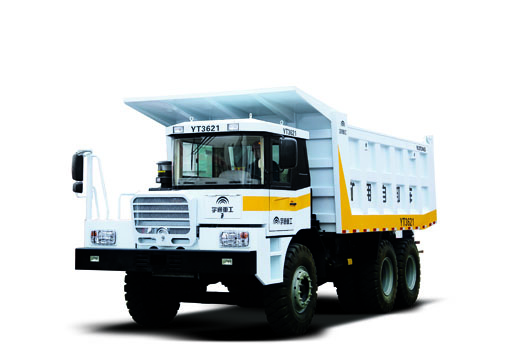
YT3621 — mid payload class
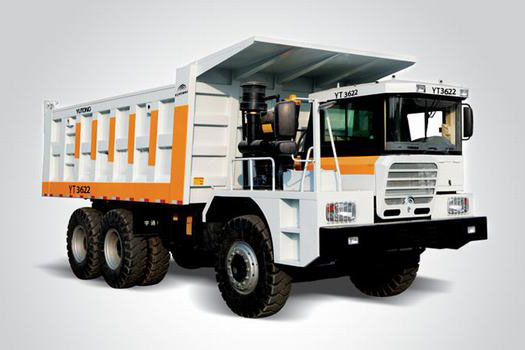
YT3622 — higher payload class
Side-by-side specification comparison
The two trucks share the same off-highway chassis philosophy, cab layout and service approach, so operators and mechanics move between them with little retraining. The meaningful differences are payload, body volume and the duty cycle each one rewards. Figures below are typical ordering data; the final spec sheet is tuned to your material density and cycle.
| Parameter | YT3621 | YT3622 |
|---|---|---|
| Payload class | Mid-range mining truck | Higher-payload mining truck |
| Powertrain | Diesel, off-highway rated | Diesel, off-highway rated |
| Body | Standard volume | Larger volume for dense rock |
| Typical pairing shovel | Mid-class loader / shovel | Larger loader / shovel |
| Best haul length | Shorter, tighter pits | Longer hauls, hardened roads |
| Strongest application | Coal, overburden, smaller pits | Iron ore, dense hard rock |
| Purchase price band | Lower of the two | Higher of the two |
Payload and body: the core difference
The decision starts with a number. The YT3621 is the mid-payload truck in this pair; the YT3622 carries more material per cycle on a larger body. On a bench with a shovel sized to the bigger truck and four to six clean loading passes, the YT3622 moves more tonnes per hour. Fewer cycles mean fewer operators, fewer tyre rotations and less wear per tonne moved, which is where it usually wins on cost.
The arithmetic only holds if the YT3622 can actually be loaded cleanly. Its larger body needs a bench wide enough to turn, a haul road hard enough to carry its higher gross weight, and a shovel bucket that fills it without long waits. If your loader needs eight passes, or your bench pinches the turn, the YT3622 sits idle while the YT3621 keeps cycling. Size the shovel and bench first, then choose the truck.
Haul road, grade and speed
Off-highway trucks are not judged on top road speed. They are judged on the sustained speed they can hold up your loaded ramp. A heavier truck pays for its extra payload with slower loaded climbing speed and more stress on drivetrain and brakes. On a long, steep ramp the YT3621 holds its cycle better; on a flatter, hardened haul where the YT3622 can keep momentum, its extra load per trip dominates.
Tyre choice follows the same logic. The YT3622 runs on larger, higher-capacity tyres matched to its gross weight. Those tyres cost more per unit and are sensitive to haul-road maintenance, so a mine with rough, ungraded roads can burn the YT3622's tyre budget faster than the headline payload saving. Tell us your ramp grade and road condition and we will flag which truck tyres actually suit you.
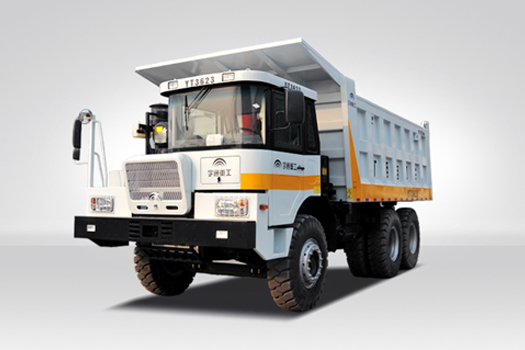
Which duty cycle fits which truck
Choose the YT3621 when: your benches are tight; your loader is mid-class; you move lighter material such as coal or overburden; or your one-way haul is short and the truck spends more time loading than hauling.
Choose the YT3622 when: your benches are wide and hardened; your shovel is sized to a large body; you haul dense iron ore or hard rock; and your daily tonnage target rewards maximum load every cycle. If you need more payload again, the YT3623 sits one class up the ladder.
Five-year TCO: price is not the decision
The YT3621 costs less to buy, but cost per tonne moved is the number that pays your bills. If the YT3622 needs two trucks instead of three to hit the same daily tonnage, it saves one cab, one operator shift, one set of tyres and one fuel budget line per year. That gap usually closes the purchase-price difference within the first contract. The reverse is just as true: an under-loaded YT3622 on a narrow bench wastes its extra mass every cycle, and the YT3621 wins on TCO.
| YT3621 | YT3622 | |
|---|---|---|
| Strengths | Tighter turning; lower capital; suits mid-size shovels | More tonnes per cycle; fewer trucks for the target; strong on dense rock |
| Watch out | Cannot maximise wide benches and large shovels | Needs wide benches, hardened roads and a matched shovel |
| Best sites | Coal, overburden, smaller / younger pits | Iron ore, hard rock, high-production benches |
Frequently asked questions
What separates the YT3621 from the YT3622?
Both are rigid-frame diesel mining dump trucks on the Yutong chassis family. The YT3622 is the higher-payload unit with a larger body; the YT3621 is the lighter, more agile model for shorter hauls and smaller loading equipment.
Which truck pairs best with my loader?
The YT3621 lines up with mid-class loaders that fill it in four to six passes. The YT3622 needs a bigger bucket. If your loader takes eight passes to fill the larger truck, the smaller YT3621 cycles faster and wins tonnes per hour.
How does haul distance affect the choice?
On short hauls the YT3621 wins on cycle time. As the one-way haul and ramp grade grow, the YT3622 spreads fuel, tyre and operator cost over more tonnes and usually lowers cost per tonne.
Are these the right trucks for an electric conversion?
Both are diesel units. If zero tailpipe and lower energy cost per tonne is the goal, the Yutong electric line-up such as the YTK105E and YTK120E is the better starting point. We can model either route against your diesel and power tariffs.
Not sure which truck fits your bench?
Send us your daily tonnage target, bench width, loader bucket size, one-way haul distance and worst ramp grade. We will model both the YT3621 and YT3622 against your numbers and send spec sheets plus a side-by-side TCO estimate. Browse the full mining dump truck range, and see our guide on how to choose a mining dump truck.