










Start from the load chart, not the headline tonnage
Most crawler crane selection mistakes happen at the first step: someone reads "55 tonne capacity" off a brochure and buys a crane that cannot lift anything near 55 tonnes at the radius their site actually requires. The headline number is the maximum lift at minimum radius with full counterweight. Real lifts happen at 8, 12, 18 metres radius, where capacity drops sharply. A good crawler crane choice is the smallest machine whose load chart covers your heaviest lift at your actual working radius, with margin. Below is the decision tree we run with customers, followed by the parameter definitions that lifting engineers usually argue about.
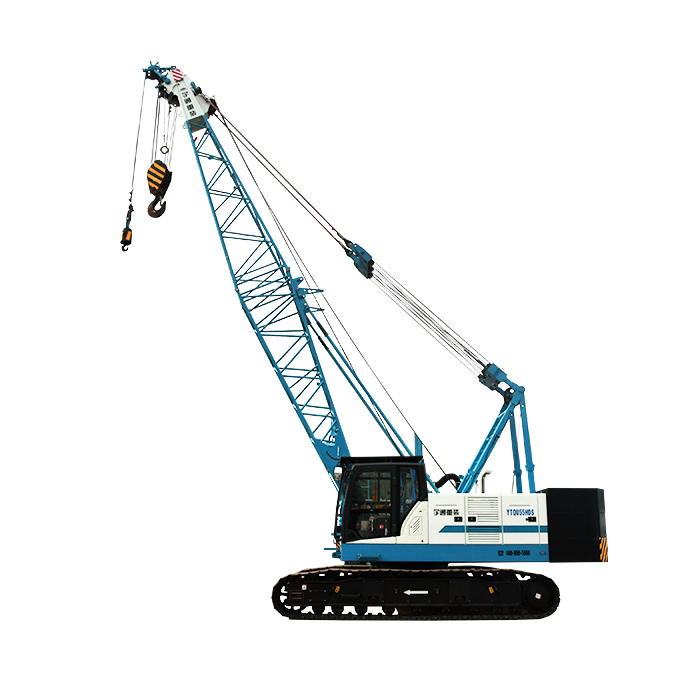
The decision tree: five questions before you spec a crane
1. Heaviest lift and its radius. List every critical lift on the project: weight, height, and working radius. Find the worst combination. Then check the load chart at that exact radius. If the chart says 35 t at 12 m and your lift is 30 t, you have the 15 percent margin that makes the job legal.
2. Site ground conditions. Soft, unprepared ground with access tracks favours the tracked platform such as the YTQU55HDS or YTQU65HDS, whose low ground pressure distributes weight over a wide track footprint. Hard, paved yards could use a truck crane instead.
3. Boom length and configuration. Wind turbine tower work needs long main boom or boom-plus-jib. Precast girder erection needs shorter boom at closer radius. Match the boom kit to the lift geometry, not just the tonnage.
4. Mobility between lifts. A crawler can walk between picks with a load suspended; it cannot drive on public roads without a low-loader. If the crane moves between distant sites daily, transport logistics and assembly time matter.
5. Budget and TCO. Compare purchase price, transport cost, assembly time, fuel and maintenance together. A slightly larger crane that lifts in one setup may beat a smaller one that needs two rigging moves.
The parameters engineers actually argue about
These four terms are where two buyers "compare" cranes that are not comparable at all. Get the definitions right and the table comparison becomes honest.
| Parameter | What it really means | How to use it in selection |
|---|---|---|
| Rated capacity at radius | Maximum load the crane can lift at a given working radius and boom configuration. | The number that decides the crane class. Always read the chart at your actual radius, not the headline max. |
| Working radius | Horizontal distance from crane centre of rotation to load hook. | Measure the worst-case radius on site. Longer radius = lower capacity. Plan the crane position to minimise radius on heavy lifts. |
| Ground pressure | Load per unit area under the tracks, in kPa. | Match to soil bearing capacity. Soft ground needs lower ground pressure or track mats. |
| Counterweight | Ballast at the rear that resists tipping moment. | More counterweight = more capacity at radius but heavier transport. Must match the load chart for each lift. |
| Boom length | Extended reach of the main boom or boom-plus-jib. | Longer boom reduces capacity. Specify the shortest boom that still reaches the lift. |
| Hook block & line parts | Number of rope parts on the hook, which sets single-line pull. | More parts = higher capacity but slower hoist speed. Match to load weight for efficient cycle time. |
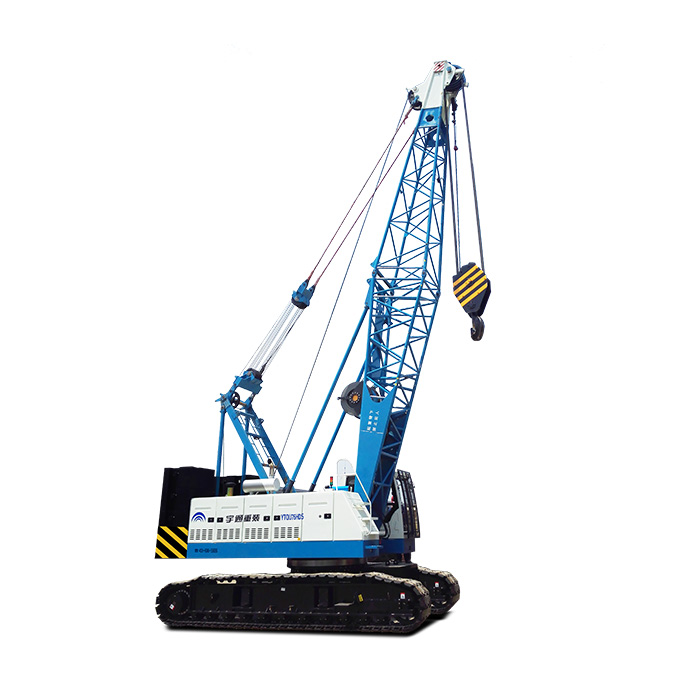
Match the class to the lift: wind, bridge, industrial, mining
Wind farm erection. Tower segments and nacelles are heavy and need long reach at radius. The 75 to 100 t class — YTQU75HDS or YTQU100HDS — handles tower sections and nacelle lifts on rough access roads where the crawler's low ground pressure matters.
Bridge girder erection. Precast concrete girders are lifted at closer radius with shorter boom. A 55 to 65 t crawler such as the hydraulic crawler crane range suits medium-span bridge work on temporary access roads.
Industrial plant erection. Steel structure modules and vessel sections in refineries and factories. The 55 to 75 t class balances capacity with mobility inside constrained plant layouts.
Mining and quarry yards. Heavy equipment maintenance lifts on unprepared ground. The crawler's ability to work off-road without outrigger pads is the deciding factor over a truck-mounted crane such as the truck-mounted crane.
Transport, assembly and the TCO that decides it
The honest comparison is not crane capacity on a spec sheet; it is mobilization cost, rigging time and fuel over the project. A crawler crane must be disassembled for road transport on low-loaders, then self-assembled on site — which takes half a day to a day depending on class. The YTQU series self-erects using its own hydraulic boom and track carrier, so no second assist crane is needed for rigging. Compare the per-day rate plus mobilization against a truck crane that drives to site and sets up in hours but cannot work on soft ground. For a single-day lift on a paved yard, the truck crane may win on logistics. For a week of lifts on a wind farm access road, the crawler wins on productivity.
| Crane type | Mobilization | Setup time | Ground tolerance | Best fit |
|---|---|---|---|---|
| Crawler crane 55-75 t | Low-loader, several trucks | Half to 1 day, self-erect | Soft, unprepared ground | Wind, bridge, off-road yards |
| Crawler crane 100 t | More trucks, heavier | 1 day, may need assist | Very low ground pressure | Heavy wind tower, large industrial modules |
| Truck-mounted crane | Drive on road | 1-2 hours, outriggers | Hard, paved surface only | Short lifts, road-accessible sites |
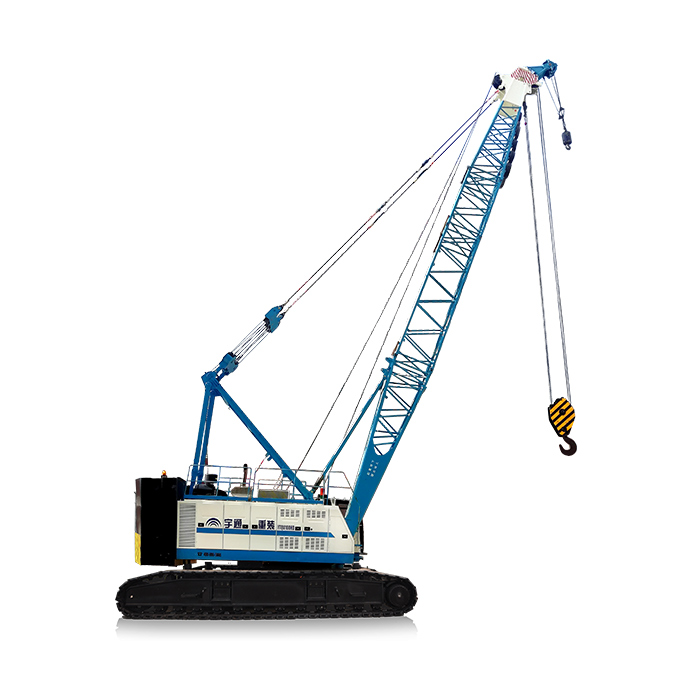
Five mistakes we see on real sites
1. Buying the headline tonnage, not the radius. A 55 t crane lifts 55 t at 4 m radius, not at 15 m. Always read the load chart at your actual radius.
2. Ignoring ground pressure. A heavy crane on soft subgrade sinks, tipping the lift. Check soil bearing capacity or plan track mats.
3. Undersizing counterweight. Running light on ballast to save transport cost puts the crane over its tipping moment. Match counterweight to the chart for the heaviest lift.
4. Over-buying boom length. A longer boom reduces capacity at every radius. Specify the shortest boom that still reaches.
5. Forgetting transport and assembly. The cheapest daily rate can be the most expensive when disassembly, low-loaders and rigging time are added. Build the full mobilization budget.
Frequently asked questions
What capacity class of crawler crane do I actually need?
Start from the heaviest lift and its working radius, not the headline tonnage. Check the load chart at the exact radius of your worst lift and add a 15 to 25 percent safety margin. A 55 t crane may only lift a few tonnes at 18 m radius.
Crawler crane or truck crane - which fits my site?
A crawler lifts and travels on tracks with no outrigger setup and works on soft ground. A truck crane drives on the highway but needs firm ground and outriggers. Choose crawler for wind farms, bridge erection and off-road yards; choose truck crane for short, road-accessible lifts.
What is ground pressure and why does it matter?
Ground pressure is the load per area under the tracks, in kPa. A crawler spreads weight over a large track footprint so it works on unprepared ground. If your site has soft subgrade, check the crane's ground pressure against the soil bearing capacity and add track mats if needed.
How does boom configuration change lifting capacity?
Main boom, boom-plus-jib and luffing jib all carry different load charts. A longer boom reduces capacity at every radius. Match the boom kit to the actual lift geometry: long boom for wind tower tips, shorter boom for close-radius precast girders.
Hydraulic or rope-controlled crawler crane?
Hydraulic offers smoother load control and easier fine positioning for precision work like wind nacelle placement. Rope-controlled is simpler to maintain in remote areas with limited service. For repeated precision lifts, hydraulic control is the safer choice.
How much counterweight do I need?
Counterweight resists the tipping moment. More counterweight raises capacity at radius but increases transport weight and assembly time. Always match it to the load chart for your heaviest lift; running light on ballast is a dangerous mistake.
What is the export lead time and warranty?
Standard configurations ship within 4 to 8 weeks; custom boom and counterweight packages take 8 to 12 weeks. The crane carries a 12-month or 2,000-hour warranty with global spare-parts support and CE / ISO documentation.
Send us your lift plan and we will size the crane
Tell us the heaviest lift weight, working radius, boom height needed, ground conditions and project duration, and our lifting engineering team will match you to the right class across the Yutong crawler crane range — from the 55 t YTQU55HDS up to the 100 t YTQU100HDS. We export to over 60 countries and build to FOB / CIF shipment terms with the full customs document set.